
Best Exercise for Diastasis Recti: Why Hypopressive Exercises May Help
You are here because you have realized you have diastasis recti (DR), sometimes referred to as an “ab separation”.
Diastasis recti is very common and you certainly are not alone. There is some thought that DR is actually a protective adaptation during pregnancy, preventing too much pressure from bearing down into your pelvis. So do not fret, it is possible that this adaptation was actually your body doing you a favor.
However, if you are here, my assumption is that you would prefer your abs to be “back together” and you are looking to take action to make it so.
That is wonderful. There are many ways in which one may go about addressing diastasis recti. Some options are better than others, but in general you do have some options. The purpose of this blog is to help you understand how to assess your options and tell you about why Low Pressure Fitness Hypopressives is my favorite tool to help improve abdominal function.
Understanding Diastasis Recti
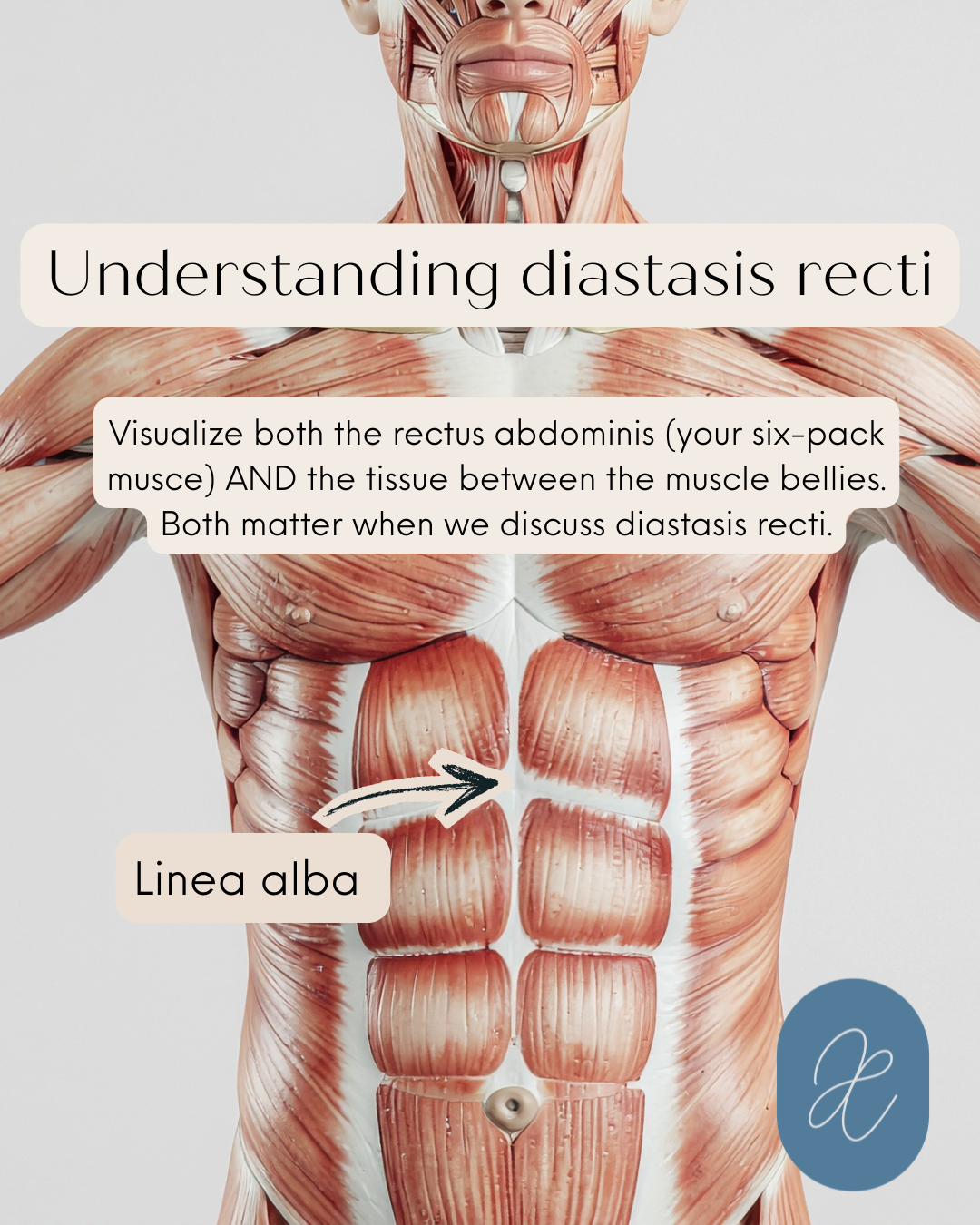
There are two factors to consider when we talk about diastasis recti.
1.) What is the distance between the muscle bellies of your rectus abdominis? This is known as the inter-recti distance. You may often hear this measured in fingers lengths oddly enough.
2.) What is the tension in the linea alba? The linea alba is the connective tissue between the two muscle bellies of the rectus abdominis.
First, let us start by discussing inter-recti distance as this tends to be the thing that popular culture focuses on. The distance between your two ab bellies often affects the appearance of your abdomen. Some women may complain that they still look pregnant. Or that they are unable to flatten the “pouch” that now appears in their lower belly. For some women, you can simply visualize a separation.
The primary consequence of a wider distance is aesthetics.
Although it can feel discouraging to have a wider separation, functionally the tension you are able to generate in the midline tissue is actually more important.
Your body often has to transfer force from one side of your body to the other during daily activity. Often from one leg to the opposite arm. This transfer requires a pathway of tension in your body so that you do not lose power across your midline.
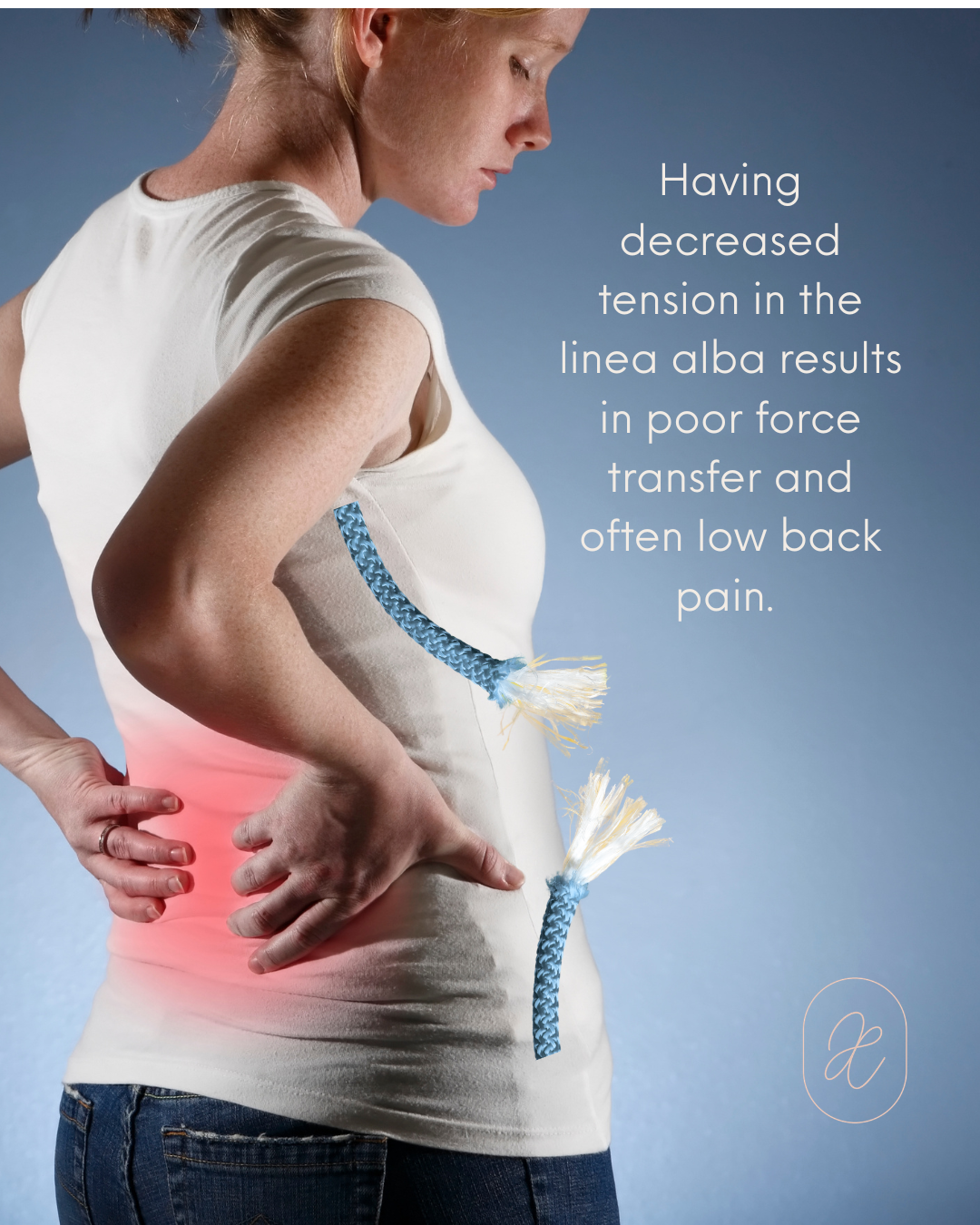
Your body has pathways of muscle and connective tissue that help you transfer force. To simplify it, imagine these pathways are like ropes.
If you do not have the tension in the midline of your abdomen it is like cutting the ropes in half and then expecting that you can create movement on one end of the rope when you pull on the opposite side.
It does not happen. You lose any force that you generated in the first half of the rope when it makes it to the middle. The same thing happens when we generate force on one side of our body and then try to transmit that force to the other side. When we lack tension in the midline it often results in the force being lost or absorbed elsewhere which can contribute to things like low back pain. It is also possible that this will make you feel weak in your daily activities.
As a clinician I am often more interested in the tension as this is what tends to be more correlated with pain and difficulty throughout the day.
However, I also believe that it is important that you feel comfortable and confident in your body.
If it is important to you that you narrow the gap of your diastasis recti, then it is important. However, I would just encourage you not to be so focused on narrowing the gap that you don’t also work on improving the tension within the tissue.
There are some exercises that focus primarily on improving the tension in your abdomen. There are other exercises that are shown to decrease the gap. And then there are exercises that do both. We will discuss all of them below.
Decreasing the Inter-Recti Distance
You have three layers of abdominal muscles. As I mentioned earlier they are all anchored into fascia that connects in the midline of your abdomen into tissue known as your linea alba.
Your deepest abdominal layer is called your transverse abdominis (TA). The primary job of this muscle is to help stabilize your torso and manage abdominal pressure.
Your obliques and your rectus abdominis (RA) comprise the other two layers. Your obliques are primarily responsible for rotation of your trunk, while your rectus is primarily responsible for flexion of your trunk.
When we consider distance between the muscle bellies we are referring to the muscle bellies of the rectus abdominis. Strengthening the rectus specifically can help decrease the distance between the muscle bellies. There was a time when the go-to exercise for diastasis was actually to do a small crunch while approximating the muscle bellies with a towel.
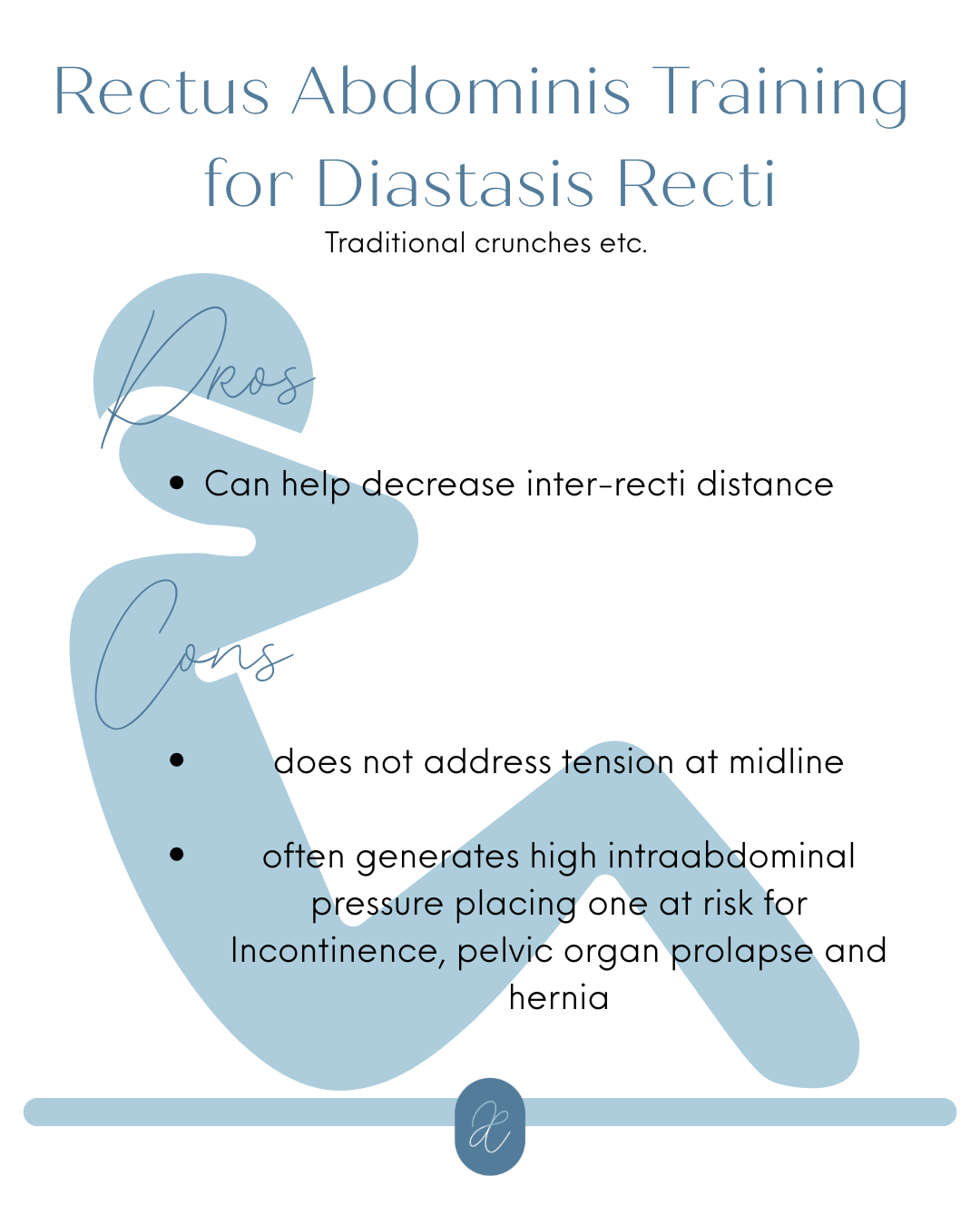
The problem with exercises that primarily target the rectis abdominis is that they do not address the linea alba and can sometimes actually decrease the tension at midline. Not only is this not functional, but it may also increase risk for abdominal hernia. Decreased tension in the midline will always be a risk factor for hernia. When you combine this with the fact that many rectus training exercises (crunches, etc) are high pressure it sometimes creates the perfect storm for abdominal hernias.
Improving the Tension in the Linea Alba
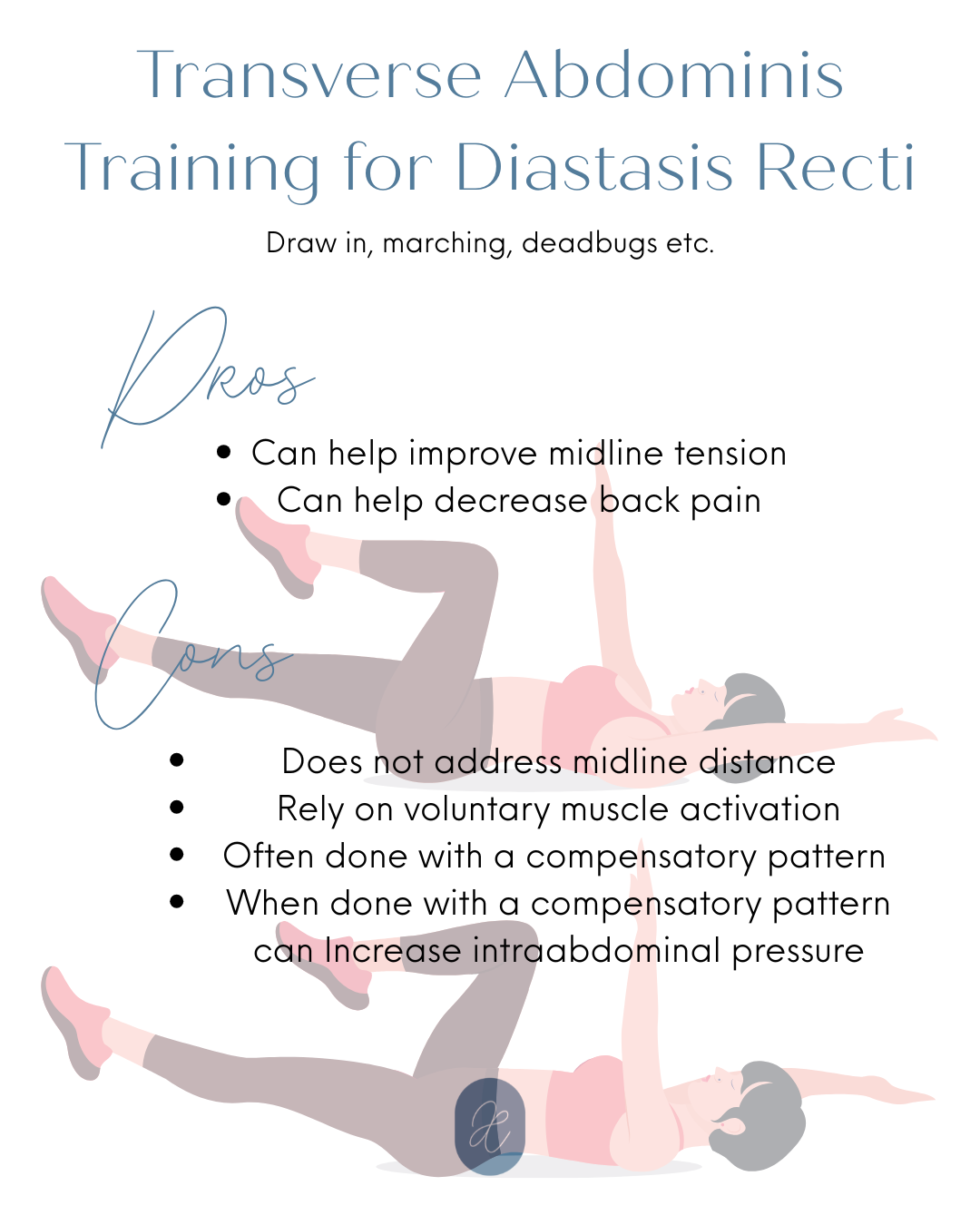
There are separate strategies to improve the tension of the linea alba. Most of these are not targeted at the RA at all but rather at the transverse abdominis. Training the TA tends to consist of exercises such as draw in maneuvers, marching, dead bugs etc.
These exercises, when done correctly, can be wonderful for improving the function of the abdomen. If your goal is to decrease back pain, improve strength etc. you may be satisfied with your results when undergoing a training program consisting of this type of activity. There are an abundance of programs available online to walk you through this type of training.
However, this type of activity may not necessarily decrease the distance between the muscle bellies of your rectus. In theory it may actually increase it due to the way that the TA inserts into the linea alba. This is not to say they cannot “improve” the appearance of the abdomen. A strong TA provides a strong foundation for your core and often leads to improved aesthetics.
The biggest draw back to these exercises is that they rely on voluntary muscle activation and are often done incorrectly. When done incorrectly these types of exercises can result in compensatory activation of your retus abdominis. This compensation places you at the same risks discussed above. I want to stress again that these exercises can be wonderful, but when you do them with the rectus as your primary activator as opposed to TA they can actually put you at risk for pressure problems such as prolapse and incontinence.
The reason why these types of exercises are often done incorrectly is because they are dependent on your ability to voluntarily activate your TA. The catch 22 is that often the decreased activation of these muscles is what contributed to the problem in the first place! Our deep abs often become inhibited during pregnancy. Sometimes they didn’t work great prior to pregnancy. It can be hard to voluntarily connect to them again without direct supervision and feedback.
The Best Exercises For Diastasis Recti
I would argue that the best exercise for DR should address BOTH inter-recti distance and tension in the linea alba .
Is there such an exercise?
One exercise approach that addresses both factors is the hypopressive maneuver. Want to learn how to perform the hypopressive maneuver correctly? Start with my online class: Introduction to LPF: Breath
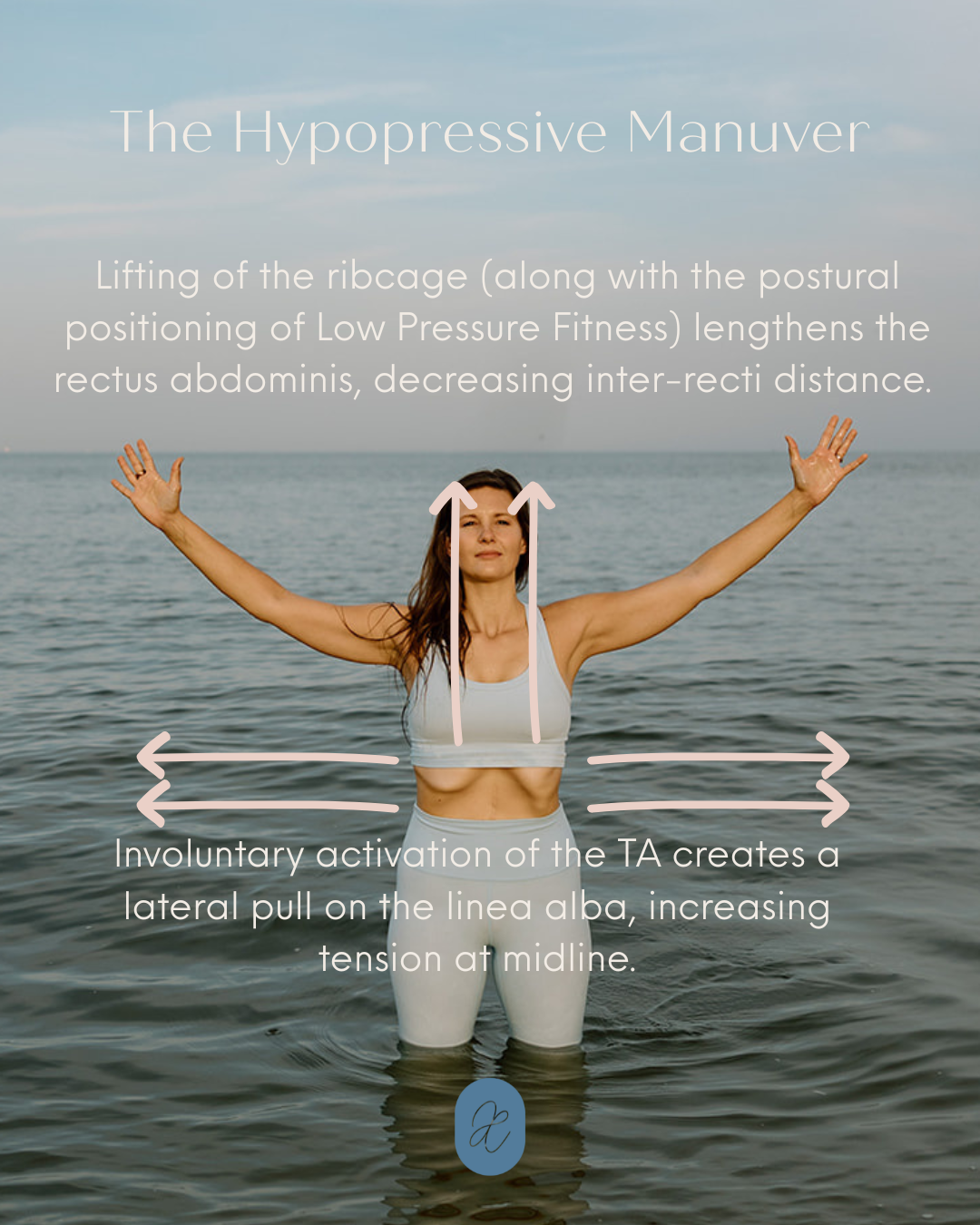
The hypopressive maneuver is a breath holding maneuver where you exhale and then open your ribcage. As you open your ribcage you are lengthening the rectus, hence bringing the muscle bellies closer together, and you are employing a lateral force that increases tension at the midline.
I also prefer the hypopressive maneuver to address DR for several other reasons. The hypopressive maneuver involuntarily activates the transverse abdomens. This means that the activation of this important muscle is not dependent on your ability to isolate and contract. Your body simply does it. I have had many clients who were unable to connect to this muscle voluntarily that “felt their abs for the first time” when learning the hypopressive maneuver. For some, the hypopressive maneuver was a prerequisite to the voluntary training discussed above.
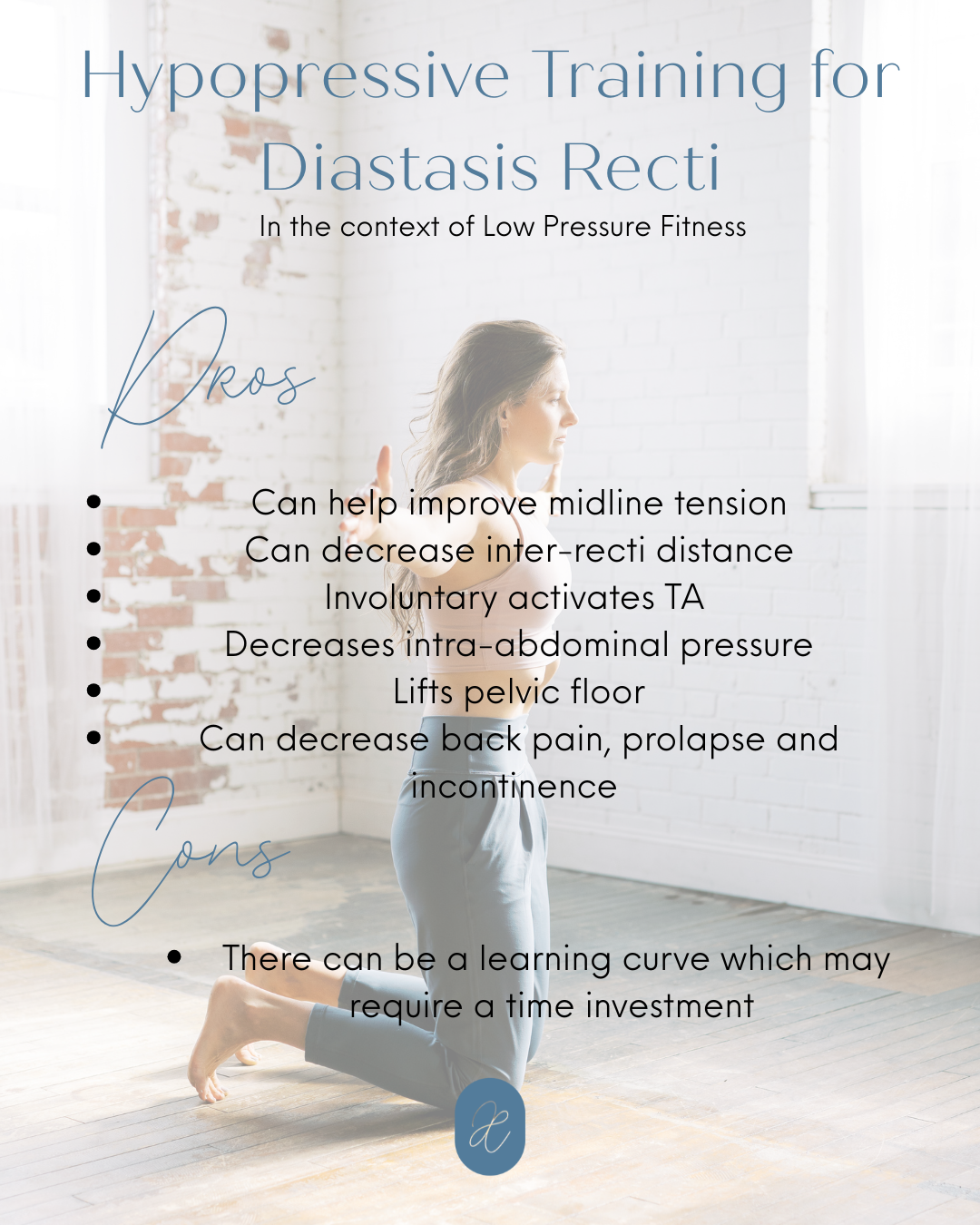
Yet another reason that I love the hypopressive maneuver for abdominal retraining is because it decreases the pressure in your abdomen. As I mentioned earlier, DR is thought to be a compensation that may be protective for the pelvic floor. As you “fix” this compensation you want to ensure that your pelvic floor and pelvic organs are not negatively affected by increased pressure. You certainly don’t want to go through the efforts to reverse your DR just to end up with a pelvic organ prolapse!
Not only does the hypopressive maneuver activate the deep abdominals, it also lifts your pelvic organs and provides a lift within the pelvic floor muscles. It truly is wonderful for both your core and pelvic floor!
Getting Started With Hypopressives
For some people learning the hypopressive maneuver is easy. For others, like myself it is more challenging. It sometimes takes an investment of time, however I have found that those who are challenged by it often benefit from it the most.
The hypopressive maneuver is beneficial in and of itself, but my true preference is to utilize it within the Low Pressure Fitness framework. I discuss the differences in my blog “What is Low Pressure Fitness”.
I have the following options to help you get started with this practice.
Online Courses For Hypopressives
I have two different self paced online courses for helping you get started with Low Pressure Fitness Hypopressives: Core Shift and IGNITE. Both options walk you through preparing your body for and learning the hypopressive maneuver along with the Low Pressure Fitness postural framework. In both of these courses I assume the hypopressive maneuver will be hard for you. I provide you with actionable steps to break down any barriers you encounter.
Core Shift is purely the movement practice, while IGNITE also explores the analogy of Low Pressure Fitness and how we often need to decrease the pressure in our daily lives.
Online Classes For Hypopressives
I also believe that Low Pressure Fitness Hypopressives is best learned with individual feedback. For that reason I also offer virtual zoom classes and private online instruction.
Which path you take is truly up to individual preference, but I do encourage you to give it a try if you would like to address your diastasis!
I hope to see you in class soon.
